

Community History
Tower Hamlets is the heartland of British Bangladeshi life , a borough whose streets carry centuries of immigrant history, and whose recent past encompasses some of the most dramatic episodes of community resistance, political transformation and cultural creativity in modern British history. From the lascar boarding houses of the 1920s to the election of the first Bangladeshi-heritage MP in 2010, Tower Hamlets has been at the centre of every chapter of the story. Today, with 34.59% of its population identifying as Bangladeshi , the highest concentration of any local authority in England and Wales , the borough stands as a testament to what a determined, resilient community can build.

Roots in Spitalfields: Making a Home in the East End
By the 1950s and 1960s, the streets of Spitalfields and Whitechapel were filling with a new generation of Sylheti settlers. They came through chain migration , one man sponsoring a cousin or neighbour from the same village in Sylhet, who in turn brought others. The pioneer boarding houses were basic: ten or twenty men sharing a terraced house, wives and children remaining in Bangladesh, remittances posted home week by week. These men worked double shifts in the garment factories of Brick Lane and Bethnal Green Road, living quietly in a city that largely did not notice them.
The area had deep immigrant heritage long before the Bengalis arrived. Huguenot silk weavers had shaped Spitalfields in the seventeenth century; Irish labourers arrived in the nineteenth; Eastern European Jewish refugees had flooded in from the 1880s. The same synagogues were becoming mosques; the same workshops were being handed between communities. Nowhere was this more eloquently expressed than the building at 59 Brick Lane: a Huguenot chapel in 1743, a Methodist chapel, a synagogue from 1891, and from 1976 the London Jamme Masjid , a Grade II* listed monument to the successive immigrant communities that made East London.
Racism, the National Front, and the Murder of Altab Ali
From the 1960s, and reaching a peak of violence in the 1970s, the Bengali community in Tower Hamlets lived under systematic racist attack. The National Front used Brick Lane and its surroundings as organising territory, openly selling their newspaper on Sunday mornings while their members assaulted Bengali residents. Physical attacks on men, women and children were near-daily occurrences. Pig meat was thrown through the letterboxes of Muslim homes. Bengali-owned businesses were firebombed. Police were largely indifferent, and those who reported attacks were frequently disbelieved or blamed.
On the evening of 4 May 1978, Altab Ali , a 25-year-old Bangladeshi textile worker walking home from work , was stabbed to death on Adler Street, Whitechapel, by three teenage boys. His murder was not an isolated incident; it came at the end of years of escalating violence. But it was the moment the community decided, collectively, that it would no longer be silent. Ten days later, approximately 7,000 people marched from Brick Lane carrying Altab Ali's coffin to Hyde Park, delivering a petition to 10 Downing Street demanding police protection and an end to racial violence. The Bangladeshi Youth Movement's slogan rang out: "Here to stay, here to fight."
The months that followed saw sustained community action to drive the National Front from Brick Lane. Self-defence groups and community patrols were organised under the principle "self-defence is no offence." In September 1978, when the National Front attempted to march through Brick Lane, anti-fascists blockaded the route. By the autumn of 1978, the National Front had been effectively broken as a presence in the area , a decisive victory won by the community itself.
The Housing Struggle and the Bengali Squatters' Movement
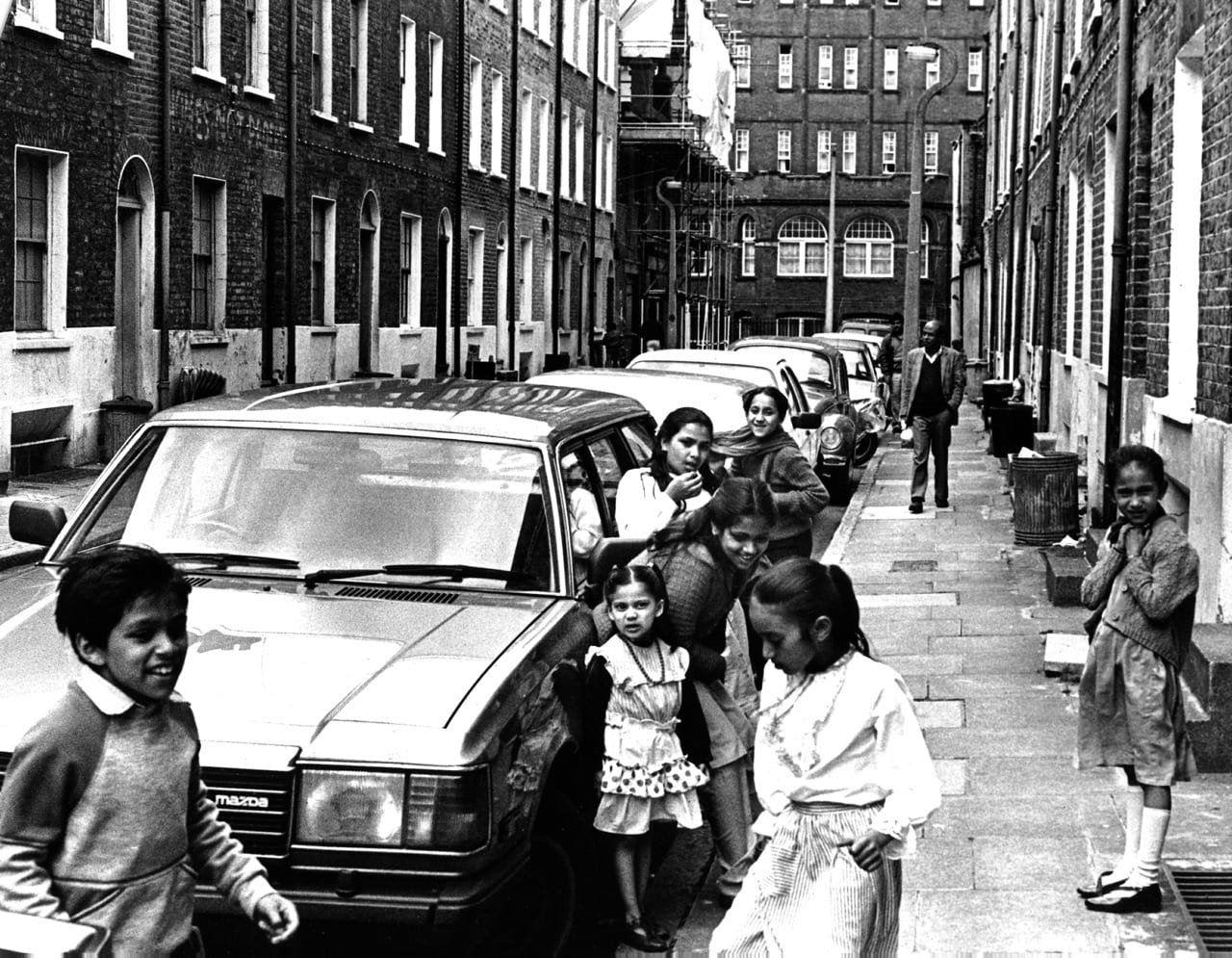
Alongside the fight against racist violence, the community was waging another battle: for decent housing. Tower Hamlets Council's housing allocation system systematically disadvantaged Bengali applicants, directing them to the most run-down estates and losing or ignoring applications. Bengali families with children lived in severe overcrowding and damp while habitable Victorian terraces in Spitalfields sat empty and derelict.
Led by the Bengali Housing Action Group (BHAG), hundreds of Bengali families began occupying derelict properties in Spitalfields, taking over entire streets of empty houses. Helal Abbas, a central figure in BHAG, became one of the movement's most effective leaders. In 1977, the Greater London Council declared a housing amnesty for squatters who had occupied derelict properties , a significant victory that rehoused dozens of Bengali families who had been failed by official systems. The Spitalfields squatters' movement stands as one of the most effective community housing campaigns in British urban history.
East London Mosque: From Seamen's Refuge to Borough Landmark
The East London Mosque did not begin in Tower Hamlets. It began at the Ritz. On 9 November 1910, the jurist and scholar Syed Ameer Ali called a meeting of Muslim and non-Muslim patrons in London, with the Aga Khan III presiding, and founded the London Mosque Fund. The purpose was to give a city that was the capital of a Muslim empire a permanent mosque of its own. Three decades of fundraising followed before three houses on Commercial Road in Stepney were purchased in 1940 and the East London Mosque and Islamic Culture Centre opened on 1 August 1941. The Egyptian ambassador officiated; the Saudi diplomat Hafiz Wahba led the first prayer. Crucially, the mosque opened not as a bare prayer hall but as a combined devotional and welfare institution: daily and Friday prayers, Eid and Ramadan observances, a library, a medical service and a burial service were all established from the start. This welfare dimension made ELM a natural part of the ecosystem that sustained the first generation of Sylheti settlers, the same world of boarding houses, welfare activists and chain migration networks in which Ayub Ali Master was operating.
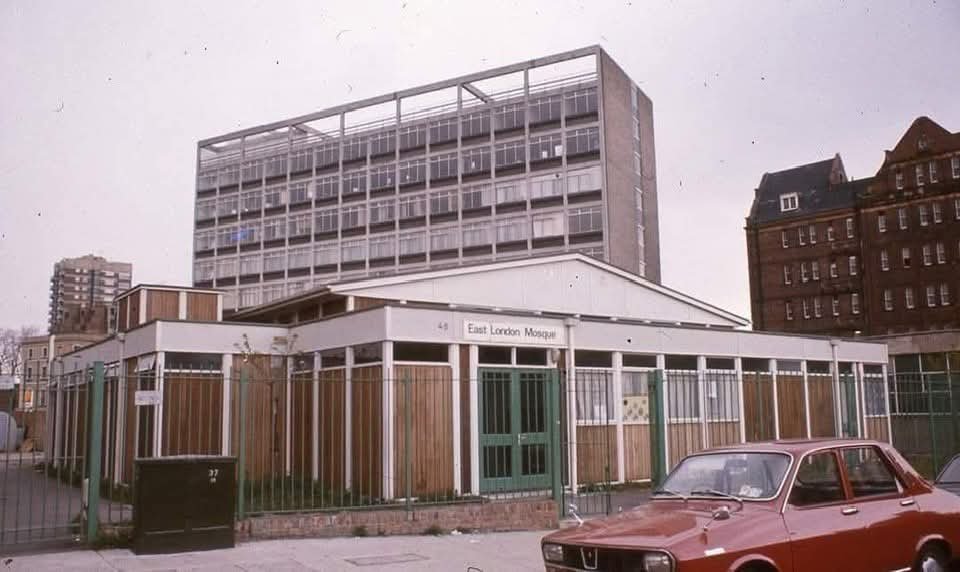
The mosque's story became inseparably a Tower Hamlets story in 1975, when the Greater London Council acquired the Commercial Road site under compulsory purchase. The community that had spent that decade fighting for the right to decent housing now found its mosque displaced as well. Temporary buildings on Whitechapel Road served as a substitute while the campaign for a permanent replacement took shape. That campaign bore fruit on 12 July 1985, when a purpose-built mosque opened on Whitechapel Road, built not for the congregation of bachelor seamen who had sustained it through the 1940s and 1950s, but for a settled, family-based Bangladeshi community whose children had been born in Tower Hamlets. The new mosque was a monument to everything the community had survived and built: a visible, permanent landmark planted in the heart of the borough.
In the years that followed, East London Mosque became one of the most significant civic institutions in Tower Hamlets, not only a place of worship but a hub of youth work, welfare, education and political engagement. It worked closely with the Young Muslim Organisation, formed in East London in 1978, and collaborated with the council and public agencies on housing, employment, youth vulnerability and school attendance. Mosque-linked campaigners were at the forefront of battles over halal provision in Tower Hamlets schools and prayer rooms for Muslim pupils. By the late 1980s ELM was also a focal point for the national Muslim response to Salman Rushdie's The Satanic Verses, a confrontation with the British public sphere that announced, unmistakably, that the Bengali Muslim community of East London had its own political voice. Not everyone in the community shared ELM's increasingly pan-Islamic horizon, but its weight in the borough was by then beyond question.
The century closed with a demonstration of that weight. In 1999, East London Mosque launched and won a campaign to secure the adjoining land on Whitechapel Road, drawing support from Tower Hamlets Council and the East London Communities Organisation in a broad coalition mobilisation. The mosque was already overflowing; the expansion was a recognition that a community once invisible (men in basement workshops, women behind closed doors, children in overcrowded schools) had built an institution that the borough itself could not do without.
Banglatown: From Garment Factories to Curry Capital
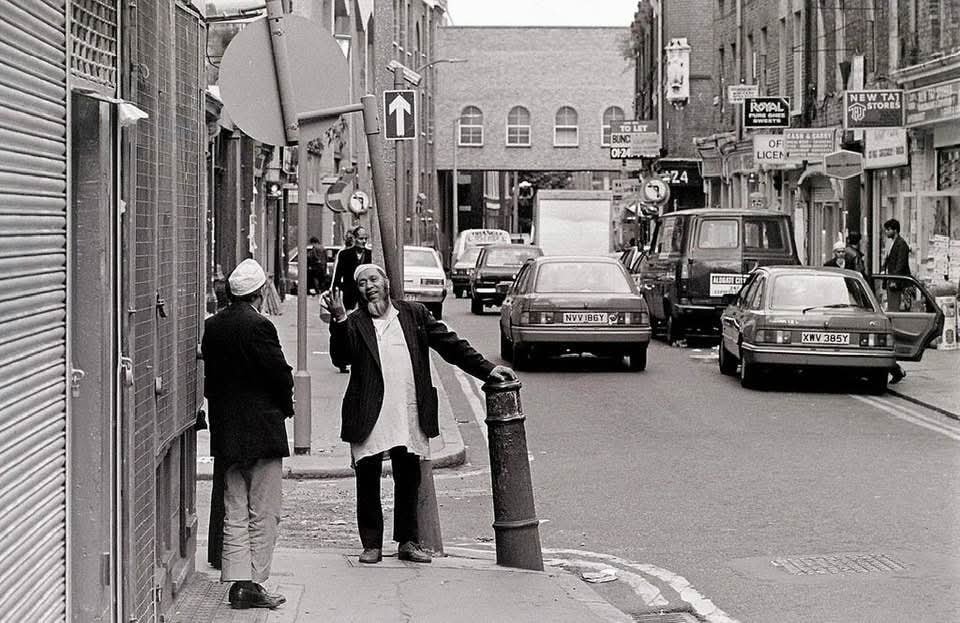
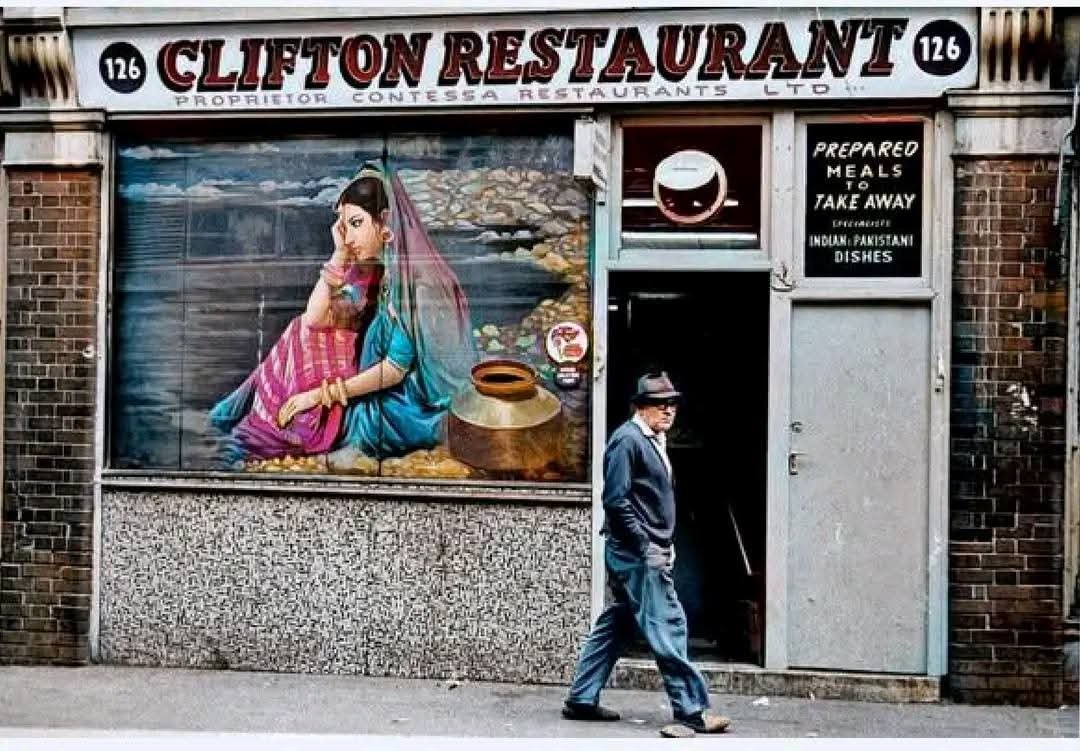
Through the 1970s and 1980s, as the garment industry contracted under competition from cheap imports, many turned to the catering trade, building on the restaurant tradition that stretched back to the lascar coffee houses of the 1920s. The transformation of Brick Lane was gradual then sudden: Jewish bakeries became curry houses, jewellery shops became sari stores, and the southern end of the street steadily filled with Bengali restaurants.
By the late 1980s and into the 1990s, regeneration funding began to formalise the area as a restaurant and cultural quarter. In 1997, Tower Hamlets Council officially designated the area "Banglatown" , the first such designation of a British Bangladeshi cultural district in Britain. At its peak, over sixty Bangladeshi-owned establishments lined the street, and Brick Lane became globally synonymous with British-Bangladeshi food culture.
Political Rise: From the Streets to Parliament
The political mobilisation forged in the anti-racist campaigns of the 1970s gradually translated into formal democratic power. Helal Abbas, who had led the Bengali Housing Action Group and the community self-defence campaigns, became Labour's first elected Bangladeshi council leader in Tower Hamlets , opening the door for the generation that followed. The defining national milestone came in May 2010, when Rushanara Ali was elected MP for Bethnal Green and Bow, becoming the first person of Bangladeshi heritage to serve in the House of Commons. Born in Bishwanath, Sylhet, she had emigrated to East London as a child. Her election was not simply a personal achievement , it was a symbolic moment for a community that had spent decades fighting for the right to be here, to be safe, and to be heard.
Landmarks, Culture and Living Memory
East London Mosque on Whitechapel Road (whose history is traced in a section above) stands alongside Brick Lane Jamme Masjid as one of the two defining religious landmarks of Bangladeshi Tower Hamlets. Tower Hamlets carries the physical memory of its community in its streets, buildings and open spaces. The London Jamme Masjid at 59 Brick Lane , a Grade II* listed structure that moved from Huguenot chapel to synagogue to mosque across nearly three centuries , is perhaps the most eloquent building in London. The Kobi Nazrul Centre on Hanbury Street, founded in 1982 and named after Bangladesh's national poet Kazi Nazrul Islam, has been a home for Bengali arts, music and culture in the East End for over four decades. The Osmani Centre on Vallance Road, named in honour of General Ataul Ghani Osmani, Commander-in-Chief of the Mukti Bahini in 1971, serves the community's health, leisure and social needs.
Altab Ali Park on Whitechapel Road , renamed in 1998, twenty years after his murder , is the community's most significant public memorial. In its south-west corner stands the Shaheed Minar (Martyrs' Monument), erected in 1999, modelled on the monument at the University of Dhaka commemorating the students killed on 21 February 1952 when Pakistani police fired on those demanding recognition of Bengali as an official language. That date , 21 February , is now International Mother Language Day, designated by UNESCO. According to the 2021 Census, 34.59% of Tower Hamlets' population is of Bangladeshi heritage , the highest concentration of any local authority in England and Wales.

